I bear in mind being 13 and sleeping over at a good friend’s home. I exploit the time period “good friend” loosely as a result of, years later, I realised that almost all of those women have been by no means actually my mates. Making her mattress within the morning, my host reached down and plucked one thing from the pillow.
“Ugh, ugh, ugh! Gross!” she shrieked.
“OMG! What’s it?” all of us yelled.
“Eugh! There are pubes in my mattress.”
“Ugh, gross.”
“No, cling on, it’s simply Emma’s hair.”
Cue squeals of laughter.
I needed to die. The feeling was sharpened by the disparity between my very own hair and my host’s – hair that I secretly coveted. It was lifeless straight, a luminously shiny black, and hung the entire manner down her again; she was complimented on it on a regular basis. Her hair framed nearly cartoonishly blue eyes, a specific blue that exists in Eire.
Till the late 1990s, being black and Irish was to have nearly unicorn standing – besides everyone loves unicorns. Many mixed-race folks I met, actually those that have been older than me, had grown up in establishments. They have been typically the “illegitimate” offspring of Irish girls and African college students. To not put too high quality some extent on it, single moms have been usually, in Eire, handled like scum. Add the shame of a black youngster and also you couldn’t actually sink a lot decrease. Whereas this wasn’t my expertise, there was nonetheless a powerful stigma related to blackness. As a black youngster with tight coils, rising up in a white, homogeneous, socially conservative nation, my hair was a relentless supply of disgrace. I grew to become fixated on it, imagining that, if it simply appeared “regular”, I, too, could be regular. I wept myself to sleep most nights between the ages of eight and 10, desperately imploring the night-time to work its magic and remodel my “choosy” curls into the headful of limp, straight hair I rightly deserved.
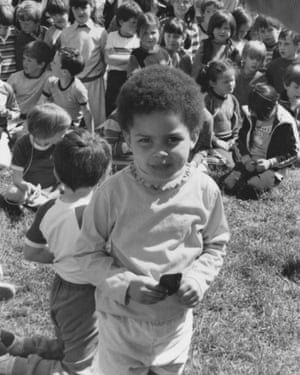
I bear in mind being advised in my mid-teens that I used to be “fortunate I used to be fairly”, which meant I might “nearly get away with being black”. I nonetheless bought the jokes about needing a flash to take {a photograph} of me, or the traditional likening of my complexion to filth, however it was my hair that remained unforgivable. Something that could possibly be achieved on my half to disguise it, to control and mutilate it, was up for consideration. The idea of leaving it the best way it grew was inconceivable.
The world round us fuels a robust narrative about hair and femininity. From fairytales to ads, motion pictures and music movies, our icons are usually lusciously locked. For a very long time, lengthy flowing hair has been one of the highly effective markers of being a girl.
However that isn’t how afro hair grows; usually, it grows up. After all, femininity – like magnificence – stays a culturally particular undertaking, and positively not one designed with black girls in thoughts. Nonetheless, we’re anticipated to adapt to those requirements, and woe betide us if we can not.
Rising up, I hardly ever noticed black girls on TV (or anyplace, for that matter), however there have been a couple of exceptions: Neneh Cherry, and Hilary and Ashley Banks of The Contemporary Prince Of Bel-Air fame. Cherry, particularly, I attempted to emulate, however her huge black curls, which grew down over her shoulders, in addition to Hilary’s brown bouncy hair and Ashley’s super-sleek jet-black locks, solely made me really feel worse. These girls had hair that appeared as unachievable for me as that of my white counterparts.
***
The stress to adapt to European requirements of magnificence is excess of a “grass‑is‑always-greener” kind of self-importance. Barely a month appears to go by with out there being one other information story a few black youngster being excluded from faculty for carrying their hair in its pure type. In 2016, protests broke out after women at Pretoria highschool in South Africa selected to defy guidelines that maintained their pure hair was “messy”. Two weeks later, a US federal court docket dominated that it was authorized to fireplace a feminine worker for having dreadlocks, deeming them “unprofessional”.
And whereas it could appear unimaginable that an grownup would cosset or certainly be abusive to a baby relying on their hair texture, it occurs extra typically than you may suppose. Contemplate Blue Ivy, the first-born daughter of Beyoncé and Jay-Z, and the topic of numerous memes and social media posts branding her “ugly”. Why? Blue Ivy’s largest crime appears to be that she wasn’t born with hair that has the feel of one among her mom’s weaves. She has the audacity to have tightly coiled hair, hair that’s uniquely black. However some folks have been so incensed by Blue’s hair {that a} petition known as “Comb Her Hair” was launched when she was two years previous.
Whenever you take a look at the best way Blue Ivy and North West, the daughter of Kanye West and Kim Kardashian, are pitted in opposition to one another in these conversations, the entire thing turns into extra sinister. Each kids are light-skinned. Nonetheless, North is said infinitely superior by grown women and men, partly due to her ambiguous racial options however principally due to her hair: a really free curl that may obtain a protracted, straight look with ease. In a 2015 article entitled How North West’s curly kinds are inspiring a era of pure hair women, American Vogue declared the then two-year-old a pure hair “icon”.
The phenomenon that we name colourism is about greater than complexion: hair texture and different options play a job in figuring out who has proximity to whiteness and who doesn’t. However loads of folks with “good” hair, the looser curl related to combined ancestry, have skilled the ache of not understanding find out how to look after it correctly, particularly these with a white main caregiver. All black hair requires data, expertise and merchandise that aren’t at all times simply accessible. In the present day, in globally linked, multicultural London, I nonetheless see mixed-race kids with dried-out, matted hair. I’m not speaking about hair that’s untidy – I’m no stickler for precision myself – I imply hair that, like mine as a baby, has clearly by no means been oiled, and infrequently untangled.
Folks typically have questions on elevating mixed-race youngsters. One of the vital sensible items of recommendation I can provide is to learn to oil and comb their rattling hair. After I was rising up there was no on-line data, and no appropriate hair merchandise in Eire. The few I did handle to get my palms on have been from my mum’s work journeys to the long-gone rag yards of Liverpool’s docklands. She was one of many first folks to import secondhand garments (their standing later upgraded to classic) to Dublin. Nonetheless, she was white, with little data or expertise of black hair care. So until one among her handful of black feminine mates – who have been emphatically not hairdressers – cornrowed my hair or texturised it, it was just about left in a scrunchie bun, a method completely unsuitable for its texture (ie it was a large number).
Later, my mum typically went to nice pains to take me to the UK to get my hair achieved, regardless that cash was tight. I’ve a sneaking suspicion that the Jheri curl perm I travelled to London for, a 12th birthday reward, places me within the operating as one of many first folks to stain the cushions and couches of early 1990s Dublin with my curl activator.
Even my mum’s mates have been extra used to making use of chemical compounds than caring for hair in its pure state. I bear in mind one notably traumatic try at texturising. A good friend of my mum’s had left the answer on longer than really useful to take into consideration my unusually defiant bounce. The fast outcome was lengthy, silky waves. I used to be ecstatic. By the next morning, it was popping out in handfuls.
Regardless of chemically stress-free my hair for about 15 years, I knew or cared little about what was happening on my head. Burns have been a recurring actuality – nearly each relaxer would depart a few scabs on my scalp. However these have been like badges of honour, testimony to the truth that the relaxer had taken. Like most of my friends, I conveniently ignored the reported hyperlinks between the chemical compounds utilized in straighteners and most cancers, fertility points and the event of fibroids. That cognitive dissonance horrifies me now.
***
Round 2010, I found a web site known as Black Woman with Lengthy Hair (BGLH), based in 2009 by the American author Leila Noelliste. It was the primary time I actually noticed my texture acknowledged, not to mention celebrated – not solely shiny, shiny curls however matt, springy naps that may be twisted, stretched, coiled and curled into any and each form. I used to be offered with all these stunning sisters rocking very stylish appears with their pure hair. And if they might do it, so might I.
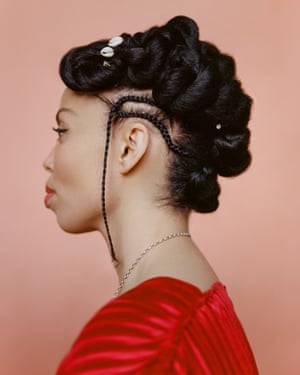
Many ladies insist their determination to go pure is just not explicitly political. The truth that they even must state this reveals how removed from the norm black hair remains to be thought-about to be. However my very own determination to cease stress-free my hair was political. I realised that, as a grown lady, I didn’t know my very own hair. I used to be not accustomed to its pure look, nor was I remotely in tune with its necessities.
When you chemically straighten your hair, you can’t unstraighten it – it’s a must to lower it off. However I simply wasn’t prepared for brief hair. The feel was unhealthy sufficient – however willingly returning to a brief afro, conceding victory to a long-vanquished enemy, was unimaginable. So I finished straightening my hair however let my roots develop for a yr earlier than chopping off the straightened ends. The next yr (2012) I grew to become pregnant, and eventually gave in to the massive chop.
I had numerous motivations. They are saying your hair grows rapidly when you’re pregnant, however it was greater than that. I knew that, if I had a daughter, it was essential she didn’t develop up with the identical warped idea of magnificence I’d held. If I had a boy, such enlightenment was simply as, if no more, essential.
Regardless of these bomb-ass-looking girls on BGLH, I nonetheless felt pure hair wouldn’t swimsuit me, no less than not as a lot as my lengthy, glossy locks. However, down for the trigger, I resigned myself to a future as a frumpy feminist. It’s extraordinary for me to keep in mind that, even at this stage, I couldn’t think about myself as engaging with unstraightened hair.
My reacquaintance with my pure hair and the start of my son proved that my physique was able to issues I had by no means dreamed attainable. Subtly, over time, I moved away from tolerating my hair to having fun with it, to loving it. I ponder if my hair’s newfound freedom, quantity and peak shifted the power round me. (It’s stated that many African teams have related the peak of 1’s hair as vital in relation to divine energy.)
My hair is now often braided not directly. One other of the misconceptions about black hair is that, to ensure that it to be “pure”, it needs to be worn in an afro. In conventional African cultures reminiscent of Yoruba, which is my paternal ancestry, girls hardly ever left their hair unmoulded; it might often be braided (irun didi) or threaded (irun kiko). On a sensible stage, it is because leaving it “out” for too lengthy leads to moisture loss and tangling. To not point out braiding additionally appears majestic.
No features are ever absolute, however it does seem that huge adjustments are afoot. Globally, there’s a motion of black girls saying: we’re sufficient; we need to be accepted for trying like ourselves. Till lately, we simply didn’t see pure hair on our TV screens. Textures reminiscent of my very own remained unseen, forbidden. Final yr’s Black Panther was a feminist milestone in that regard: the feminine characters have been tech geniuses and warrior commanders – they usually had tightly coiled afro hair, a primary for a serious Hollywood manufacturing. It confirmed our hair as stunning however, greater than this, it confirmed it as regular. If I had grown up seeing girls with hair like mine on display screen, it might have made me really feel proud – and much much less alone.
• That is an edited extract from Don’t Contact My Hair by Emma Dabiri (Allen Lane, £16.99). To order a replica for £13.99, plus postage and packing, go to guardianbookshop.com or name 0330 333 6846.
If you want a touch upon this piece to be thought-about for inclusion on Weekend journal’s letters web page in print, please electronic mail weekend@theguardian.com, together with your identify and tackle (not for publication).
Source link
Low Price. Fashion News Clothing & Shoes
Post a Comment